


Understanding Drought Stress and Why Trees Need Water
Trees need water for a number of critical physiological functions. They absorb water mainly from the soil via their roots. Water is added to the soil through natural precipitation, irrigation, or in rare cases from capillary rise from ground water. In the landscape, water leaves soil in three ways:
- Available water is absorbed through plant root systems, transported upward, and lost via transpiration from leaves and bark.
- Water evaporates from the soil surface.
- Water drains through soil due to gravitational forces.
As soil dries, the remaining water molecules are held more and more tightly by soil particles. At some point, water molecules are held so tightly they become unavailable for plant use. This is referred to as the permanent wilting point.
During drought stress, normal physiological functions of plants are interrupted, including:
- Photosynthesis is reduced. Water is an important component of photosynthesis, and the process is negatively affected during dry periods.
- Stomata, which regulate water and gas exchange in the leaf, may close. This prevents water vapor and oxygen from leaving the plant, as well as carbon dioxide entering the plant (which is essential for photosynthesis).
- There is likely a reduction in carbohydrate production and storage (due to reduced photosynthesis).
- Plant growth is reduced (leaves, shoots, roots, fruit, etc.).
Plants under drought stress also have weakened defense systems, which can lead to problems with certain insects and diseases. Fortunately, trees can tolerate some drought and dry conditions. It is difficult to detect short-term drought stress in trees. Prolonged drought stress, however, may result in wilting, early leaf drop, smaller-than-normal leaf size, early fall leaf color, scorch on leaf margins, purpling or browning of leaf tissue, and increase in disease or insect pressure.
Additionally, drought stress can result in the death of fine feeder roots which absorb the water for the tree. This can make trees slower to recover from drought stress even when irrigated.
If drought stress is severe or persistent enough it can kill trees. Depending on the situation, death from drought stress may happen relatively quickly (in weeks or months) or may take several years.
Almost all tree species will need some supplemental irrigation in arid regions of the Western United States. Keeping your trees well-watered will contribute to their overall health, growth rate and longevity in your landscape. However, overwatering trees can also be detrimental.
Watering Established vs Non-Established Trees
A tree is considered established when it has grown its root system to approximately three times the diameter of its canopy. When this happens, the growth rate of the tree’s canopy will increase and then become consistent. Trees generally take a season to establish for each inch of trunk caliper, e.g., a two inch tree will take two years to establish. Trees which are still being established require more frequent irrigation with smaller amounts of water.
Established trees in the landscape do not require water as frequently as those that were recently planted. However, in Colorado’s dry climate, almost all trees will need supplemental irrigation during dry periods year round. A general rule of thumb is that the bigger a tree becomes, the more water it will need.
Tree Roots and Their Location
Types of Tree Roots
Woody Roots (Transport Roots)
These are larger roots (1 cm to 30 cm or more in diameter). They provide anchorage, serve as storage sites for starches and sugars and are part of the system that transports water, nutrients, and other compounds through the tree from fine feeder roots to leaves. They absorb very little water or mineral nutrients from the soil.
Fine Feeder Roots (Absorptive Roots)
These are smaller roots (.4 to .008inches or less in diameter) which are the primary sites of water and mineral nutrient absorption. They are often short lived and can be killed or suppressed by low soil oxygen levels, drought, or fluctuations in soil temperature. Such events are stressful but healthy trees rapidly reproduce fine feeder roots.
Size and Extent of the Root System
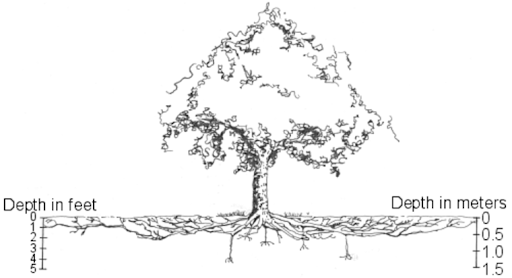
A mature tree’s root system often occupies a much wider area than its canopy. Depending on the species of tree and soil conditions the spread of a tree’s root systems may be two to five times the width of its canopy or even greater in some cases.
The depth of a tree’s root system is governed by the availability of water, mineral nutrients, soil oxygen and the species of tree. In clayey, compacted or perpetually wet soils (soils with a shallow water table) roots tend to be shallower due to low soil oxygen levels in the deeper layers of such soils. In sandy soils, roots also tend to be massed near the soil’s surface. Sandy soils have low levels of mineral nutrients and having a large concentration of roots near the surface allows trees to capture nutrients being released from decomposing leaf litter. In loamy soils, tree roots tend to be deeper as there is sufficient oxygen and nutrients to support their growth.
In clayey, compacted, or perpetually wet soils, 90-95% of roots will be in the top twelve inches and 50% will be in the top four inches of soil. In favorable soil conditions, 90-95% of roots will be in the top thirty-six inches and 50% will be in the top twelve inches of soil. [Figure 1]
Determining When to Water
Unlike other types of plants, it is difficult to look at a tree and determine if it needs water. Water should be applied when the top four to six inches of soil has dried. This can be measured by touch or with a slender screwdriver. A common method is to poke the screwdriver into the soil in several places around the tree, both inside and outside the dripline (the imaginary line at the edge of the tree’s canopy). If the screwdriver can easily penetrate the soil to a depth of six to eight inches, there is no need to apply water. If, after watering, you cannot penetrate to a depth of six to eight inches, water again. Repeat this process until you have adequate soil moisture.
Amount of Water
The amount of water to apply will vary depending on the size and age of the tree, the time of year, natural precipitation, soil type, watering method, and other factors. Aim to apply one to two inches of water (620-1240 gallons of water per 1000 square feet) every two weeks during the growing season. Another method which can be more useful for smaller trees is to apply ten gallons of water for each inch of trunk caliper diameter per watering. Example: a four inch caliper tree needs forty gallons of water per watering. These amounts are recommendations only. Adjust as necessary for your local situation and precipitation.
Trees growing in sandy soils will need to be watered more frequently but with less water applied in a given irrigation than trees in clay soils as sand drains more quickly and doesn’t hold water well. On the other hand, clay soils can hold more water but normally absorb it more slowly. Such soils may benefit from “slower” irrigation methods or “cycle and soak” (watering for a period, letting the water absorb into the soil, and then watering again).
Methods of Watering
Sharing Lawn Irrigation
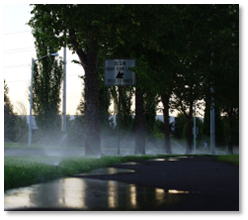
When mature trees are planted in/near the lawn, using a lawn sprinkler system is an easy and effective way to water them. [Figure 2] Remember that the turf and tree roots are located in the shared rooting area, and both are using the applied water. A good goal is to apply enough water to the lawn to compensate for evapotranspiration (ET); this is the amount of water used by the plants and lost from evaporation. The amount will vary throughout the season. A typical bluegrass lawn may need one inch of water early in the summer (May-June), up to two inches during July and August and one inch in September and October. You can consider running additional cycles (perhaps a couple times per month) to supply additional water to tree roots. To measure how much water you are actually applying in an irrigation cycle, place several cups in the area and measure the amount of water in them. Multiply this by the number of days the system runs per week:
- 0.5 inches applied/cycle three days per week = 1.5 inches of water applied per week.
- 1.5 inches of water applied per week, four weeks/month = 6 inches of water per month.
Hose and Sprinkler
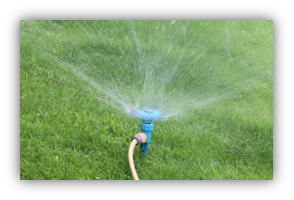
A hose and sprinkler are an effective way to water trees. [Figure 3] A hose and sprinkler should always be used when the lawn irrigation system is turned off. Place several cups in the pattern of the sprinkler to collect output or attach a water meter to the hose to determine how much water was applied. The most effective place to water mature trees is just outside the dripline, NOT at the trunk. Depending on the type of sprinkler, it may take thirty to sixty minutes of run time to apply one inch of water.
Drip Irrigation
Drip irrigation is often used to water newly planted trees. One mistake many homeowners make is leaving the drip irrigation in the original location for years. Emitters must be moved out and additional ones added as the tree grows or drought stress may occur. Depending on the location and tree species, drip irrigation may be eliminated after the tree matures. When using drip, understand the systems’ emitter size and output to calculate the number of gallons applied during each irrigation cycle. For example: If you have two emitters that each put out two gallons of water an hour that would mean the system would put out four gallons an hour.
Soaker Hoses and Tubing With “Inline” Drip Emitters
Soaker hoses are probably most effective on smaller trees, but they can be used on larger trees if there is enough hose available to create a circle at the tree’s dripline. Soaker hoses apply water very slowly and need to run for long periods of time. It may take several hours to apply one inch of water, depending on pressure and hose size.
A similar but more durable option is plastic tubing with drip emitters inside it at regular intervals. This is sometimes called “drip tape” or “dripline.” Ideally the tubing would be run in a circle around the tree near its drip line.
Self-Watering Devices
These systems, sometimes known as “Gator Bags,” are best used only on newly planted trees. They are not an effective or practical way to water mature trees. Even with newly planted trees there are some potential problems. First, the bag must be monitored to ensure that it is filled with water. Second, bags are often dark in color and when left around the trunk of the tree, can trap excess heat. Third, bags may keep the trunk and surrounding soil overly moist, leading to disease and insect problems. Self-watering devices may be used for the short term but are not a reliable way to irrigate.
Deep Root Watering Devices
Since most tree roots are not located deep within the soil profile, deep root waterers are not an effective method of irrigating. In addition, the device must frequently be moved around the tree, which is time consuming. A hose and sprinkler combination are a better option.
Fall and Winter Watering
Watering trees in Colorado’s dry fall and winter months is extremely important. Moist soils hold more heat than dry soils, leading to additional growth in the fall and increased time for establishment. Adequate soil moisture also leads to better plant hardiness and ability to survive cold, dry winters. Aim to water trees and other woody landscape plants monthly when natural precipitation between October and April is less than an inch per month.
Precipitation can be in the form of snowmelt or rain, but snow moisture can vary. Water on days when the temperature is above 40 degrees. Apply an inch of water early in the morning to allow it to soak into the soil before freezing at night. For additional information, refer to CSU Extension Fact Sheet Fall and Winter Watering.
This publication, reference GardenNotes #657, is developed as part of the Colorado State University Extension Master Gardener Program.