


Quick facts…
- Effective weed management involves the implementation of prevention, eradication, and control strategies.
- Control reduces a weed population to a level where they do not represent significant competition against more desirable vegetation or impede land use.
- A weed management system integrates two or more methods into a plan of operation.
- Establishing competitive perennial vegetation is a key to prevent weed reinfestation after control.
Introduction
Weeds in small acreages represent a significant reduction of beneficial land uses like grazing pastures and wildlife habitat. While in home gardens, weed management can typically be managed by physical removal, and in conventional agriculture herbicide application represents the most economically feasible way to manage weeds, small acreages are often too big to pull weeds on and often host a diversity of plants that would be severely damaged by herbicide applications. An integrated weed management strategy is crucial for reducing weed infestations in small acreages to allow for beneficial uses such as recreational or grazing pastures. Maintaining a weed management strategy also plays a role in the bigger picture. It prevents the spread and proliferation of noxious weeds that pose economic and ecological risks to agricultural fields and native forests, prairies, and wetlands.
The following strategies can be used in combination to prevent and eradicate weeds on small acreages on a long-term.
Where do weeds come from?
Many weeds were inadvertently introduced decades ago through contaminated crop seed imported from other countries. Other plants were intentionally introduced as ornamentals or alternative crops and forages, and have since become highly competitive, displacing more desirable vegetation.
On a smaller scale, there are many ways fields can become infested with weeds, as well as many opportunities to prevent those infestations from becoming more serious. Tumbleweeds, for example, are plants that dry out and break off at the base, rolling across fields and roads with the wind and dispersing seeds as they tumble. Other weed seeds are spread through irrigation water in ditches, by attaching to animals’ fur or to people’s clothing and footwear, and by hitchhiking on farm equipment or landscaping machinery such as mowers. Hay and animal feed can also contain weed seeds, which may be spread across fields even after passing through animals. Highly disturbed sites, such as construction areas, can further exacerbate weed problems. Soil moved from one location to another often brings buried weed seeds to the surface, allowing previously dormant seeds to germinate. Fill dirt transported between construction sites can therefore be a significant source of new infestations.
Recognizing the major sources of weeds and weed seeds in your fields can help you develop an effective prevention plan that targets those pathways of introduction. Purchasing high-quality seed or hay, establishing perennial vegetative buffers around fields or ditches to outcompete weed seedlings, planting perennial grasses, using mulch in landscaped areas, allowing grasses to recover after grazing, and cleaning mowing or other equipment used in different fields are all effective strategies for preventing weed infestations. Keep in mind that some weeds are likely to be present regardless of the management strategy you choose; however, weeds should not become the dominant plants in your landscape, farm, or pasture.
Prevention
Prevention is the first line of defense and keeps weeds from occurring or increasing in an area. Preventive techniques include planting high quality, weed-seed-free crops or grass seed. Other important preventative measures include controlling existing infestations, so they do not increase in size.
In grazed pastures, establishing rotational grazing programs and resting periods for the grasses to regrow is critical. Perennial vegetation like forage grasses can be highly competitive against weeds. In pastures where grasses remain short for most of the year or where large sections are left bare either by overgrazing or disturbance, weeds can find optimum habitat where it is easy to establish.
An important aspect of preventing weed infestations starts with knowing how weeds reproduce and spread. Weeds can be categorized by their lifecycles in annuals, biennials, and perennials. Annual weeds only live for one growing season, which typically lasts 1 year or less and reproduce solely by seeds. Biennial weeds live for two years and also spread by seeds only, while perennials live more than two years and may spread from seeds, but some perennial plants, known as creeping perennials, can also reproduce by pieces of vegetative tissues. Preventing seed formation for annuals and biennial weeds is crucial to eliminate infestations. While perennial weeds may reproduce by other means, preventing seed formation may also be beneficial as it prevents the spread of perennials to other areas of the field through seeds that can be carried by the wind, birds, insects or other means.
Eradication
Eradication is the removal of weeds from an area so they will not recur unless reintroduced. If eradication creates an open area, one weed problem may be cured simply to create another one. If eradication is necessary, revegetate the ground with desirable vegetation to prevent another weed infestation. Eradication is desirable for small patches, 10 to 100 feet in diameter, but not always for larger ones.
Control
The most common management strategy reduces a weed population to a level where they do not represent competition against desirable vegetation or beneficial land uses. Adequate control can also prevent future infestations. There are four control methods: cultural, mechanical, biological, and chemical.
Cultural control methods promote growth of desirable plants that can outcompete invasive weeds. Seeding is the most commonly used cultural control method and must be combined with control methods that decrease the target weed population and gives the seeded species an opening in the environment to successfully germinate and establish (colonize). Proper fertilization, irrigation and planting at optimum densities let crops compete with weeds and not with each other. While nitrogen fertilization increases yields in grass hay meadows, it also fosters weed establishment and growth. In grazed or non-grazed pastures, fertilization should be carefully watched. Grass fertilization in dryland small acreages is often not needed, and residue management may be a better strategy to incorporate nutrients back into the soil. Fertilize cautiously, especially with nitrogen, and only when necessary, as determined by soil testing. To mulch or smother weeds can also be considered cultural control or physical control as it excludes light from weed seedlings to suppress growth.
Mechanical control methods physically disrupt weed growth. Tillage, hoeing, hand-pulling, mowing and burning are examples.
Biological control methods use an organism to disrupt weed growth. Often the organism is an insect, disease, fungus or nematode as a natural enemy of the weed. This is called classical biological control. Institutions like the Colorado Department of Agriculture have recommended methods of biological control for noxious weeds that target a specific weed and do not represent a negative impact on local insect or plant species. Classical control is not the only form of biological control. Livestock can be effective weed-management tools if managed correctly. However, improper livestock management (overgrazing) can be extremely damaging to the environment and exacerbate weed problems.
Chemical control methods use herbicides to disrupt weed growth. The first rule of any pesticide use is to read the label before using the product and follow all directions and precautions. Herbicides can have different levels of residual activity, which is one of the main reasons to read the label carefully. The residual activity of the herbicide determines how long after the herbicide has been applied it will stay active and kill the targeted weeds. It also helps determine when it is safe for people or animals to re-enter the field or when new plants can be seeded or planted. (NOTE: Avoid using soil-active herbicides, such as Tordon, Banvel/Vanquish/Clarity, Perspective, or Telar near windbreak plantings and other desirable woody vegetation. Plant injury or death can occur. Do not allow any herbicide to drift onto woody or other desirable vegetation for the same reason.)
Integrated weed management
An integrated weed management system uses two or more control methods. The key to long-term success is to encourage desirable plant growth with prescribed grazing, optimum fertilization, when necessary, and/or irrigation (cultural control) where applicable. Plant competition is an often overlooked tool and should be used first, but not exclusively. When enhancement of the desirable plant community is necessary, make sure you seed at optimum rates to ensure establishment and subsequent competition with weeds. Generally, perennial, sod-forming grasses compete best with weeds.
Till, hoe, hand-pull, mow or mulch (mechanical control) if desired. Herbicides (chemical control) are powerful tools that should be used judiciously, not exclusively. Biological controls can also be part of a system. Several natural enemies are available through the Colorado Department of Agriculture (CDA). Livestock grazing can be effective, depending on the weed species, if grazing rotations are properly managed for weed control.
This is a list of common weeds on small acreages and effective methods to control them.
Canada Thistle
Cirsium arvense
Colorado State University research shows that mowing is advantageous under habitat conditions where the root growth of Canada thistle may be restricted, such as high water tables. Mow Canada thistle (Figures 1 and 2) to 2 to 4 inches during the growing season to stress plants and prevent seed formation. Mow monthly, starting at bolt to early bud-growth stage (approximately mid-June). Alternatively, till at three-week intervals where appropriate. Tillage or mowing stresses Canada thistle and forces it to draw upon stored root nutrients. The key to controlling Canada thistle and other perennials is to exhaust root nutrient stores, regardless of the control procedure used, this may take several years to achieve, especially on established plants.
Allow Canada thistle to recover (cease mowing or tillage) in mid-August so ample foliage is present in fall to intercept herbicides. Some plants may recover and flower in the fall. Spraying the plant in the early stages of flowering can also be very effective. These are some recommended herbicides for controlling Canada thistle:
| Herbicide | Rate | Timing |
| Tordon | 1 qt/ac + 0.25% v/v surfactant (1 qt surfactant/100 gallons) | Spring, any time after emergence |
| Milestone | 7 fluid oz/ac | Late bolting or pre-flowering bud stage |
| Banvel/Vanquish/Clarity | 2 qt/ac | Rosette |
| Telar | 1 oz/ac | Bloom stage |
Any of these herbicides kill legumes, such as alfalfa or clover. Don’t use Tordon near water, particularly irrigation water. The herbicide can end up in a field other than a grass pasture and injure susceptible crop species or desirable woody vegetation.
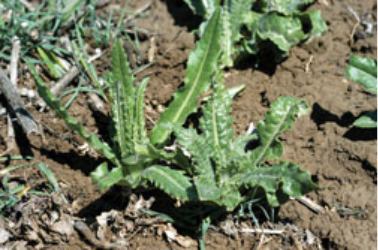
Figure 1. Canada thistle rosettes growing from creeping roots in early spring.
Sometimes Canada thistle invades grass pastures that are in good condition. In situations where the grass population is adequate, a single management method may be sufficient because plant competition from perennial grasses (cultural control) is already in place.
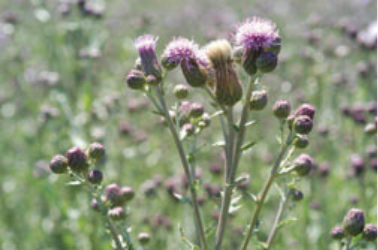
Figure 2. Canada thistle flowers and flower buds.
Usually, reseeding is necessary to fill an open space left by killed thistle and provide competition to thistle that recovers. Perennial grasses may be sown the same season any of these herbicides are used. Dormant seeding is recommended (seed in late fall so grass seed will not germinate and emerge until the following spring). Wait at least 30 days after herbicide application.
This system combines mechanical, chemical, and cultural control. Canada thistle is difficult to control and may recover. Repeat procedures as necessary.
Leafy Spurge
Euphorbia esula
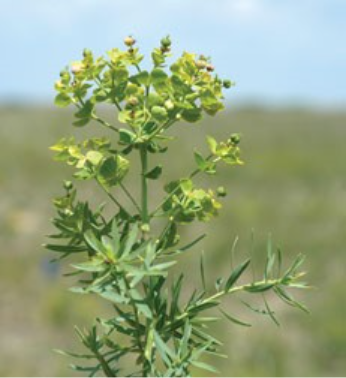
Figure 3. Leafy spurge flowering to seed set growth stage.
Hoeing, grubbing or hand-pulling small infestations before seed production in 2-3 week intervals is effective. Mowing is not a recommended method for eliminating leafy spurge, but mowing every 2-4 weeks can reduce seed formation.
Heavy cultivation at a depth of 4 inches over 2 years or more can help exhaust root reserves. Cultivation every 2 weeks during the growing season and every 3 weeks during late summer or early fall is necessary. One single cultivation may encourage more plant growth.
Targeted grazing with sheep and goats has proven effective at reducing infestations. The combination of grazing and fall applied herbicides to plant regrowth has shown better results than grazing alone.
Chemical control is most effective in mid-August for plant regrowth. Some effective herbicides include:
| Herbicide | Rate | Timing |
| 2,4-D | 1-6 qts/ac | Flowering in early summer or fall regrowth |
| Tordon 22k (picloram) * | 1-2 qts/ac + non-inoic sufractant at 0.25% v/v | Flower stage or in the fall |
| Picloram + 2,4-D | 1-15 pts picloram/ac + 2-3 parts 2,4-D/ac | Spring at true flowering for 3-5 years |
| Imazapic (plateau) | 8-12 oz/ac | Preemergence or early post emergence in the fall |
| Paramount (quinclorac) | 8-16 oz/ac | In spring or at flowering |
| *Long residual activity, may injure young germinating grasses. | ||
Biological control agents are available from the CDA. Six species of flea beetles from the genus Aphthona have been established in Colorado since 1989. The CDA distributes a mix of A. nigriscutis, A. lacertosa, A. flava, A. cyparissiae and A. czwalinae. The flea beetle larvae feed on the plant’s root system, while the adults attack the leaves of the plant. Although flea beetles are very effective at controlling leafy spurge, they may be hard to establish. They prefer high densities of leafy spurge and are discouraged by heavy disturbances like grazing and mowing. Sandy or seasonally flooded soils are not recommended sites for establishing flea beetles.
Leafy spurge is a persistent, hard-to-control weed that often recovers from control attempts. If necessary, repeat the management system after three to four years. Reduced herbicide rates often can be used at that time.
Musk Thistle
Cardus nutans
Musk thistle (Figure 4, 5, and 6) is a biennial plant. The key to successful management is to prevent seed formation. Musk thistle thrives in highly disturbed pastures with high moisture and sunlight. The weed grows more in pastures in poor condition than those in good condition. Reseeding, once its populations are reduced, may be a necessary final management step to prevent reinfestation by musk thistle.
Mechanical removal of the plant can be effective. Use a sharp shovel or other tool to remove the plant down to 2-inches below ground level to prevent resprouting. Mowing bolting plants that are about to flower is very effective at preventing seed formation. Plants often regrow after mowing if done before bolting, for this reason, single mowing is often not effective at controlling musk thistle because plants can be at different life stages in the field.
Grazing is not considered an effective method of control, as animals tend to avoid musk thistle, although horses, cattle and goats will graze on flowerheads. Sheep may graze on rosettes.
Effective herbicide use depends on the timing. Some effective herbicides include:
| Herbicide | Rate | Timing |
| Tordon 22k | 0.67-1 qt/ac | Flower bud to senescence (best for fall treatments) |
| Milestone | 3-5 fl oz/ac | Preemergence in winter to early spring or post emergence to seedlings up to flower bud |
| Vanquish/Clarity + 2,4-D | 0.75 a.e./ac (2,4-D) + 0.25lb a.e./ac (clarity) | Rosette |
| Telar | 1-2.6 oz/ac | Fall or spring rosettes before bolting |
| Escort | 0.5-1 oz/ac | In spring to young weeds before flowering or fall to new rosettes |
Note: If treating in early flower stage, do not allow the pink portion of the developing flower to exceed the size of a dime. Research at Colorado State University indicates little to no viable seed is formed when Telar or Escort are applied during these growth stages.
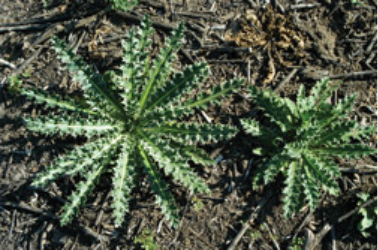
Figure 4. Musk thistle rosettes; note cream colored mid-rib and frosted appearance of leaf margins.
The musk thistle rosette weevil (Trichosirocalus horridus) is available from the Colorado Department of Agriculture. Larvae feed on the meristems of rosettes and developing shoots, causing plants to be less vigorous and produce fewer seeds. In past years the musk thistle seedhead weevil (Rhinocyllus conicus) was used as a biocontrol, but distribution stopped because the weevil also attacks native thistles.
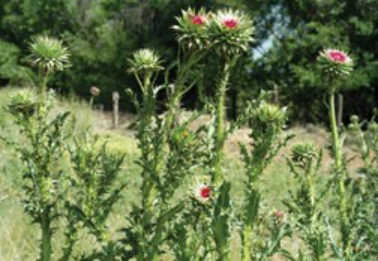
Figure 5. Musk thistle flower bud growth stage; note large spade-shaped bracts under developing flower.
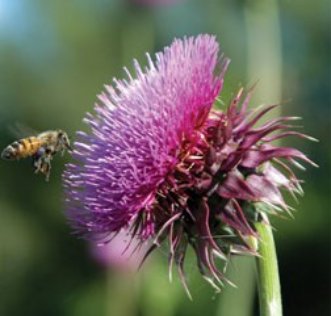
Figure 6. Musk thistle flower; note lack of stem leaves beneath flower.
Diffuse Knapweed
Centaurea diffusa
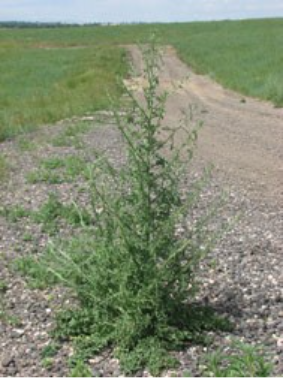
Figure 7. Large diffuse knapweed plant.
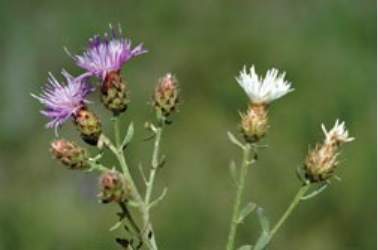
Figure 8. Diffuse knapweed flowers; color varies from white to purple; note well-developed fringe on sides of bracts and long terminal spine on bract tip; brack tips can be dark colored.
Diffuse knapweed (Figure 7 and 8) is a short-lived perennial, biennial, or occasionally an annual that reproduces seed. Diffuse knapweed invades overgrazed pastures, forms dense stands and may be toxic to horses.
Physical removal or damage can suppress and sometimes eliminate infestations depending on timing and frequency of treatments. Repeated hand pulling is necessary in most cases. Pulling most of the root out is also important to prevent regrowth. Hand pulling may need to be repeated for up to 5 years to completely eradicate the plant.
Mowing from late bud to early bloom stage will prevent seed formation. Mowing at rosette stage is not recommended as plants will regrow and produce seed. Grazing may be restricted by growth stage of the plant. Sheep and cattle are known to graze on diffuse knapweed in early spring when the plant is small and succulent, before other desirable vegetation starts greening up. Diffuse knapweed is otherwise not palatable for grazing once it starts elongating.
Spring- or fall-applied herbicides include:
| Herbicide | Rate | Timing |
| Tordon 22k | 1-2 pt/ac | Rosette to mid bolting stage or fall rosette |
| Milestone * | 5-7 oz/ac | Rosette to bolting stage. Fall applications to new growth |
| Transline (cropyralid) | 0.67 – 1.33 pt/ac | Optimal in spring at beginning of bolting up to bud stage or to fall regrowth |
| Curtail (cropyralid + 2,4-D) | 2-4 qt/ac | Same as above |
| *One of the most effective treatments. | ||
The most successful and available biocontrol agent for diffuse knapweed is the seed head feeding weevil, Larinus minutus. This weevil feeds on the plant’s seedheads and foliage. The root boring weevil Cyphocleonus achates is also a known established biocontrol in Colorado that attacks both diffuse and spotted knapweed and may become available through the CDA. There are other biocontrol agents that are established in Colorado, but collection is currently not available. Those include two root boring weevils, two seed head feeding flies and seedhead feeding moths. As with any integrated weed-management system, biocontrol should be combined with seeding of perennial grasses.