


The march of native, spring wildflowers continues in the Grand Valley. While not quite the same show we had after last year’s wet winter, we’re still seeing a lot of our favorites, including many that are also at home in our gardens and planted landscapes.
Here are a few recent finds:
Colorado paper flower (Psilostrophe bakeri). Colorado paper flower is found in western Colorado as well as in Idaho. Its bright yellow flowers, salt tolerance, and ability to thrive in irrigated and non-irrigated conditions makes this member of the Asteraceae family a nice choice for waterwise gardens.
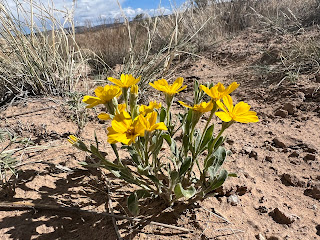
flowering in Mesa County in May.
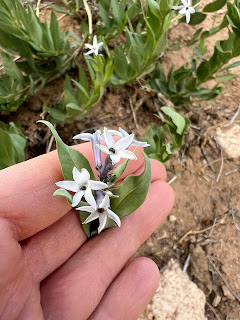
Jones’ bluestar (Amsonia jonesii). This member of the Apocynaceae or dogbane family is one of my all-time favorites and I almost missed seeing it flower this year. It is prolific at one site in Grand Junction. Luckily, this past weekend, I was able to catch the very tail-end of its flowering.
Jones’ bluestar has whitish-blue flowers that are reminiscent of little stars. And the smell! It is definitely worth getting down to give these beauties a sniff. They have a sweet smell, a little like a lilac. This perennial is a Plant Select and is available at nurseries. Once established Jones’ bluestar does not need any supplemental water.
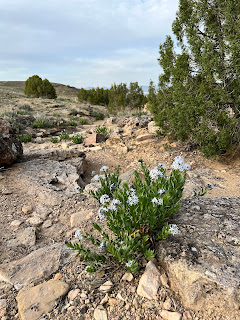
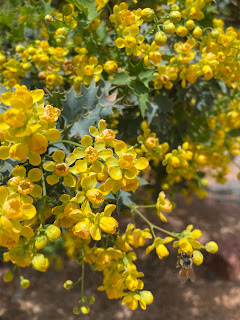
Fremont’s barberry/ Fremont mahonia (Berberis fremontii). This member of the barberry family (Berberidaceae) is at home on pinyon juniper slopes, as well as in our gardens. This evergreen shrub has blue-green prickly leaves throughout the year and abundant yellow flowers in spring that attract a number of different pollinators.
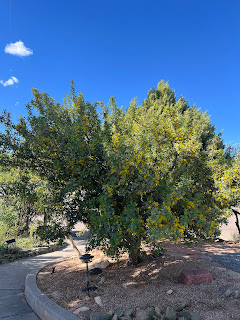
At the CSU Extension office in Grand Junction, there is a Fremont’s barberry in the cactus garden that has been trained to a single stem (and others in the Ute Learning Garden) that are more shrubby. This is another native with a sweet, almost honey-scented flower.
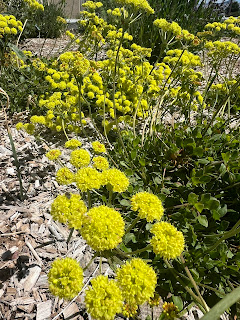
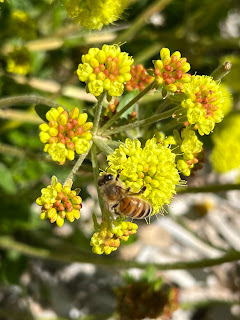
Golden sulphur flower (Eriogonum umbellatum var. aureum). So far this year, I have only seen this member of the buckwheat family (Polygonaceae) flowering in front of the CSU Extension office in Grand Junction. There, we have planted Kannah Creek® buckwheat and it is flowering prolifically right now. The flowers are in umbellate inflorescences and attract a ton of pollinators, including lots of flies. The flowers have a distinct odor, though it isn’t one I linger on, like I do with the bluestar or the Fremont’s barberry. The flowers turn more orangey as they mature, adding some additional color to the landscape. In the fall, the leaves turn reddish-purple, providing some great color over the winter. This is a Plant Select plant that was originally collected around the Grand Mesa.
Seek out these plants as you make your way around the Western Slope or around nurseries and native seed catalogs.
Sources:
- Ackerfield, J. 2022. Flora of Colorado, 2nd Ed. BRIT: Fort Worth, TX.
- Cox, R.W., and J.E. Klett. 1984. Evaluation of Some Indigenous Western Plants for Xeric Landscapes. HortScience 19(6):856-858.
- Plant Select