


Quick facts…
- Insecticidal soaps can be used to control a wide range of plant pests. Small, soft-bodied arthropods such as aphids, mealybugs, psyllids, and spider mites are most susceptible to soaps.
- The ease of use, safety, and selective action of insecticidal soaps appeal to many people.
- Limitations of insecticidal soaps include the need to wet the insect during application, absence of any residual effectiveness, and potential to damage some plants.
- Home remedies made from household liquid soaps or cleaning products should not be used as pesticides.
Introduction
Soaps have been used to control insects for more than 200 years. Modern insecticidal soaps, or soap salts, are potassium salts of fatty acids—molecules containing potassium attached to long carbon chains. Depending on the length of the carbon chain, soap salts can be effective insecticides, fungicides, and herbicides. The first pesticide product containing soap salts was registered by the EPA in 1947.
Insecticidal soaps kill insects by disruption of cell membranes, causing the insect to die from rapid dehydration. Soaps and detergents may also remove the protective waxes that cover certain insects, making them more vulnerable to natural dehydration or other injuries.
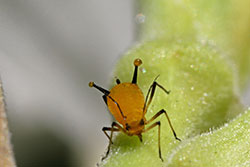
controlled with insecticidal soaps.
Using Insecticidal Soaps
Please note that pesticide recommendations are subject to change at any time. It is always the pesticide applicator’s responsibility, by law, to read and follow all current label directions for any pesticide being used. Due to changing laws, labels and product registrations, some of the recommendations given in this writing may no longer be legal by the time you read them. If any information in these recommendations disagrees with the label, the recommendation must be disregarded. No endorsement is intended for products mentioned, nor is criticism meant for products not mentioned. The author(s), Colorado State University, and Colorado State University Extension assume no liability resulting from the use of these recommendations.
Soaps and detergents act strictly as contact insecticides, with no residual effect. To be effective, sprays must be applied directly to and thoroughly cover the insect targets. This usually means spraying undersides of leaves and other protected sites. Insects that cannot be completely wetted, such as aphids within curled leaves, will not be controlled.
Several insecticidal soaps are distributed for control of insects and mites. Available under a variety of trade names, the active ingredient of all of these products is potassium salts of fatty acids.
Susceptible Insects
In general, insecticidal soap sprays are effective against small, soft-bodied arthropods, such as aphids, young scales, whiteflies, psyllids, mealybugs, and mites. Both beneficial and pest mites are affected. Larger insects, such as caterpillars, sawflies, and beetle larvae, are generally immune to soap sprays. Large, adult flying insects with stronger exoskeletons (e.g. lady beetles and bees) are generally not affected, but larval stages may be susceptible.
Application
Certain plants are sensitive to insecticidal soap sprays and may be injured. When in doubt, test soap-detergent sprays for phytotoxicity problems on a small area a day or two before an extensive area is treated. Be sure to read and follow all label instructions.
Limiting the number of soap applications can also be important to prevent plant damage, as leaf damage can accumulate with repeated exposure. However, because of the short residual action, repeat applications may be needed at relatively short intervals (four to seven days) to control certain pests, such as spider mites and scale crawlers.
Soaps and detergents can offer a relatively safe and easy means to control many insect pests. As with all pesticides, however, there are limitations and hazards associated with their use. Understand these limitations and carefully follow all label instructions.
Homemade Soap Remedies
Insecticidal soaps are chemically similar to liquid household soaps. However, there are many features of commercial insecticidal soap products that distinguish them from dishwashing liquids or soaps sometimes recommended in social media or the popular press. Insecticidal soaps sold for control of insects:
- are designed specifically to kill insects;
- are tested for efficacy;
- are selected to minimize potential plant injury; and
- comply with legal requirements for pesticide labels.
Because household soaps are usually less expensive than insecticidal soaps and seem environmentally friendly (although they may not be), they present a tempting substitute for labeled insecticidal soaps. Homemade pesticides are not consistently formulated nor tested, so there is no evidence to support whether they control pests. Dish soaps contain powerful detergents that can injure plants, damage soil, and contaminate waterways. Many household soap components are not biodegradable.
Furthermore, household soaps used as pesticides are of questionable legality. Household soaps do not fall under the Federal Insecticide, Fungicide, and Rodenticide Act (FIFRA) classification of registration-exempt minimum risk pesticides (25(b) list products) because they contain a mixture of components—detergents, degreasers, viscosity modifiers, emulsifiers, preservatives, etc.—rather than single chemicals that can be used in pesticide products without registration.
For these reasons, homemade soap solutions are not recommended for insect control.
Reference: CSU Fact Sheet 5.547