


Quick facts…
- Many houseplant insect problems are introduced by infested plants.
- Carefully check plants before purchasing and quarantine them in a separate area for a few weeks to avoid introducing new pest problems.
- Changes in cultural practices can help control many houseplant insects, such as fungus gnats.
- Several insecticides are available to control houseplant pests. For some pests, biological controls also exist.
Introduction
Houseplants are susceptible to attack by many insects and mite pests. Some of these houseplant pests can cause extensive damage to the appearance and health of the plant while others are simply a nuisance. Plants not vigorously growing and/or under stress may be susceptible to insect and mite injuries.
Infestations of insects including scale, mealybugs, and whiteflies are almost always established from infested plants recently purchased or received as gifts. As a precaution, new plants should be placed in quarantine in a separate area of the household for at least three weeks. A careful inspection at the end of this time helps determine the presence or absence of pests.
Methods Used to Control Houseplant Pests
Syringing plants. Many household plant pests can be controlled, at least in part, by washing the plant periodically with a vigorous jet of water. This is particularly effective for spider mites and aphids, which are most readily dislodged.
Dunking. Infested plants can be placed into a bucket or tub of water for 1-2 hours to control insects residing in the upper part of the plant. The plant can tolerate several hours underwater; the insects will drown.
Cultural changes. Watering affects houseplant pests in a couple of different ways. Excessively moist soil favors the development of problems with fungus gnats. However, plants placed in very hot, dry sites are prone to problems with spider mites.
Handpicking. Larger houseplant insects can be controlled by hand picking. This is especially useful for scale insects and mealybugs. Regularly using small, hand-held vacuums assists in controlling whiteflies.
Trapping. Yellow sticky traps can be useful to reduce the number of insect pests that fly – whiteflies, winged aphids, and fungus gnats. These traps are sold commercially, or you can easily make them by cutting bright yellow cardboard and covering it with petroleum jelly or some other sticky material. However, trapping alone will not eliminate problems because much of the population, including the younger stages, remain on or around the plants.
Sanitation. Seriously infested plants are often best discarded because they usually require lengthy and extraordinary efforts to control the pests. They may also serve as a source for infesting other plants. You can use periodic “host-free” intervals to cause insects that survive for short periods without feeding to die out.
Biological controls. Under certain conditions, natural enemies of houseplant pests are effective in reducing the problem to acceptable levels. However, they are relatively difficult to acquire and are usually available only through specialty suppliers. See Table 1 for a list of several biological controls for pests associated with houseplants.
Table 1. Summary of biological controls for insects and mites affecting houseplants and interiorscapes.
| Species | Pest(s) controlled | Comments |
|---|---|---|
| Predator mites | Spider mites | Several species of predator mites are available that feed on spider mites. Check with a supplier as to the species best adapted to the environment of the plantings. Predator mites are quite perishable, so they must be used soon after purchase. |
| Whitefly parasites (Encarsia formosa, Eretmocerus californicus) | Whiteflies | Can effectively manage greenhouse whitefly if temperatures are maintained at an average of at least 72 to 75 degrees F. Inefficient at lower temperatures. Available through several mail order suppliers. |
| Mealybug destroyer (Cryptolaemus montrouzieri) | Some mealybugs | A species of lady beetle that feeds solely on young and eggs of mealybugs. This species was used successfully in some indoor plantings but requires high mealybug populations to maintain. Most effective in warm temperature settings. Available through several mail order suppliers. |
| Mealybug parasite (Leptomastix dactylopii) | Mealybugs | Has provided control of mealybugs in atrium settings. Available through some mail order suppliers. |
| Aphid predator midge (Aphidoletes aphidimyza) | Aphids | Larvae are predators of aphids. These have been most effective at higher temperatures. During winter supplemental lighting must be provided to maintain a minimum of 12 hours daylight or they become dormant. |
| Green lacewings | Aphids, primarily | A general predator that feeds on a wide variety of insects and may help suppress mealybugs, scales, and spider mites. Widely available from garden catalogs, often as eggs. |
Alcohol. A spray of alcohol, or alcohol dabbed onto insects, is well known as a useful control of mealybugs. However, using alcohol on plants may cause injuries such as leaf burn. Carefully test a small part of the plant if you attempt to use this method and be cautious to keep the alcohol limited to the insect pest.
Insecticidal soaps. Insecticidal soaps (potassium salts of fatty acids) are one of the most commonly available houseplant insecticides. These are used as dilute sprays (one to three percent concentration) and can help control many houseplant insects and spider mites. Many liquid hand soaps and dishwashing detergents also have insecticidal effects, although there is potential for plant injury with such treatments.
Horticultural oils. Diluted sprays of oils (petroleum distillates, mineral oils) are some of the most useful insecticides for houseplant pests, capable of controlling scales, young whiteflies, and spider mites. These are highly refined oils that primarily act by smothering.
Neem. Some houseplant insecticides are derived from seed extracts of the neem plant, a commonly grown tree in many tropical areas. Neem seed contains materials that disrupt insect growth and can be useful for control on developing whiteflies and some other insects. Neem seed also contains oils that may be used in a manner like horticultural oils and is sold in products labeled as containing “clarified hydrophobic extracts of neem seed.”
Pyrethrins and pyrethroid insecticides. Pyrethins are a common ingredient in many houseplant and garden insecticides. They are a natural product derived from flowers of a certain (pyrethrum) daisy. Pyrethrins are fast acting, have a very short persistence (a few hours), and have low toxicity.
Several “synthetic pyrethrins,” better known as pyrethroids, are also commonly used. These are synthetically manufactured insecticides based on the chemistry of the natural pyrethrins. Some of these pyrethroids, such as resmethrin and sumithrin, are also fast acting and have a short persistence like the natural product. However, other pyrethroids, such as permethrin, cyfluthrin, and bifenthrin, may persist in active form on foliage for several days. Pyrethroids may have differences in their ability to control houseplant pests, such as bifenthrin, which is much more effective than other pyrethroids against spider mites.
Systemic insecticides. Some insecticides, known as “systemic insecticides,” can be absorbed by plants. Those used on houseplants are sold as granules or as stakes. They are applied to the soil for the roots to absorb.
Bacillus thuringiensis A naturally occurring soil bacteria, Bacillus thuringiensis, can control many insects. It is a commonly used microbial insecticide. Different strains of this bacteria occur which may have different effects on insects. For example, one strain “kurstaki” is commonly sold to control caterpillars on vegetables and ornamental plants. Another strain, “israelensis” or “H-14,” can control certain larvae of gnats, blackflies, and mosquitoes. It is sold under the trade names Gnatrol and Knock-Out Gnats to control fungus gnat larvae in houseplants.
Notes on using pesticides:
Follow the cautions listed below when using pesticides on houseplants to avoid exposure and plant injury. Follow all label instructions and guidance precisely. If a given plant or pest is not listed on the label, you should not use that pesticide and should seek an alternative option.
- Only use pesticides that are specifically labeled for use on houseplants. Most yard and garden pesticides do not allow this use.
- If possible, take the plant outdoors before spraying to minimize pesticide exposure within the home.
- When using aerosol sprays, do not apply closer than 18 inches to the plant, or injury may occur from the spray. This precaution appears on most label use directions.
- Avoid treating plants that suffer from environmental stresses such as temperature extremes or drought to minimize potential plant injury.
- If granules or plant stakes containing DiSyston are used, take care when watering after insecticide applications as excess water may spread some pesticides away from the container. Read the label for any concerns about pesticide mobility.
- Always read and follow instructions on the label!
Common Houseplant Pests
Greenhouse Whitefly
Greenhouse whitefly (Trialeurodes vaporariorum) is a common pest of several houseplants such as poinsettia, ivy, Hibiscus, and Lantana. Greenhouse-grown vegetables, such as tomatoes and cucumbers, are also frequently infested. Damage is caused by insects sucking sap from the plant. Heavily infested plants may drop leaves prematurely and have reduced vigor. During feeding, whiteflies also excrete sticky honeydew that detracts from the plant’s appearance.

Winged adults are the stage most seen. They are somewhat gnat-like and covered with fine white wax. Adults lay eggs on the leaves. These eggs hatch in three to seven days to produce the immature nymph stage. Most feeding injuries to the plant occur by the nymphs. Whitefly nymphs are scale-like in shape, translucent color, and immobile. Feeding on the leaf undersides, whitefly nymphs are often inconspicuous and easily overlooked. After feeding for two to four weeks, whitefly nymphs change into an inactive “pupal” stage. This stage typically lasts one to two weeks, before adults emerge. Adults may be active and lay eggs for two months if conditions are favorable.
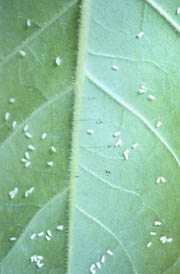
The greenhouse whitefly is a tropical insect unable to overwinter outdoors in Colorado. Freezing temperatures or a relatively short host-free period eliminates greenhouse whitefly. Although most houseplant problems originate from the purchase and movement of infested plants, some whiteflies can reproduce and infest new plantings during the warm summer months.
Management. Yellow sticky cards or tape can be used to trap adult whiteflies. On small plants, adult whiteflies can be eliminated by vacuuming.
Insecticides containing pyrethrins or related insecticides (tetramethrin, resmethrin, sumithrin) are the most effective chemical controls for adult whiteflies. Horticultural oils, neem insecticides, and insecticidal soaps may control nymphs on leaves. The systemic insecticide imidacloprid is highly effective against greenhouse whiteflies. If using imidacloprid, be aware that it can have negative impacts on other non-target insect species, especially bees.
Mealybugs
Mealybugs are soft-bodied insects that suck sap from plants. This weakens the plant and causes leaves to shed. Mealybugs also excrete large amounts of sticky honeydew. Mealybugs can be found on coleus, cactus, lantana, hoya, jade, poinsettia, and more… Root-infesting mealybugs are associated with African violet and gardenias.
When full grown, most female mealybugs produce a large amount of cottony material to lay hundreds of eggs. The eggs hatch within a few days. The newly emerged insects, known as crawlers, move about the plant. Oftentimes, infestation of new plants occurs during this movement. Mealybugs mature in approximately two months.

Mealybugs may infest different areas of the plant. Although populations on foliage are most visible, mealybugs also infest roots, and some are predominantly associated with roots. Some species tend to move to roots when growing conditions are less favorable but return in high populations on stems and leaves when plants are actively growing.
Management. Swabbing individual mealybugs with alcohol is useful for control. Dilute alcohol sprays (25 to 50 percent concentration) or insecticidal soaps can also be used. However, before applying these treatments, be sure to test a small area because some plants may become injured. Alcohol and soaps are strictly contact sprays with no residual action; they will only work upon contact with the insect pest. Root-feeding stages of mealybugs will be missed with these treatments.
Sprays of pyrethroid insecticides (tetramethrin, bifenthrin, permethrin) are usually effective for mealybug control. Soil-applied systemic insecticides disulfoton and imidacloprid can also be effective.
Biological controls for mealybugs include a species of ladybird beetle (the “mealybug destroyer,” Cryptolaemus montrouzeri) and a type of parasitic wasp (Leptomastix dactylopii). However, these are expensive and difficult to use effectively, which limits their application primarily to large indoor plantings where using insecticides is not desirable or possible.
Spider Mites
The twospotted spider mite (Tetranychus urticae) is one of the most common houseplant pests. Unlike whiteflies and mealybugs, the twospotted spider mite can survive year-round outdoors in Colorado, going dormant during the winter. Original infestations of houseplants may arise from plants kept outdoors from mite migration from outdoor plants, or by acquiring infested plants from a greenhouse. Once established on a plant, spider mites can crawl short distances or be carried or blown to other plants.
Spider mites feed on plant sap, producing small wounds on the outer plant cells which appear as white flecks. In the beginning of a spider mite infestation, these injuries occur as small patches on the leaf underside near the base of leaf veins. As damage progresses, the leaves have a generalized “off” color that appear as a graying or bronzing. Spider mites also make webbing and in very high populations the webbing may be very visible. Often heavily infested leaves drop prematurely. Common hosts include ivies, dracaenas, figs, hibiscus, Norfolk Island pine, and scheffleras.

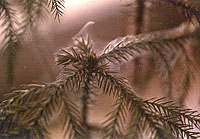
Spider mites have a short life cycle that can be completed in one to two weeks under favorable conditions. Approximately five eggs may be laid daily by a mature female. Eggs hatch within a couple of days and the newly emerged nymphs feed almost continuously.
Management. Spider mite control can be difficult. Heavily infested plants should be disposed of whenever possible since they can serve as a source of new infestations. Fundamentally important is providing optimal growing conditions as spider mite problems can be aggravated by a poor environment.
The most effective controls include washing and increasing humidity around the plant. Small plants can be repeatedly washed with a jet of water from a shower or kitchen sprayer. This forces off the mites and eggs. If done over the course of several weeks, mite populations should be reduced to low levels.
The Twospotted spider mite is difficult to control with pesticides. Horticultural oils are probably the most effective spray. Bifenthrin, found in many houseplant insecticide preparations, can also be effective for spider mite control. Insecticidal soaps are marginally effective.
In large indoor plantings, using predator mites may be considered. Several species of predator mites are available and can be used successfully to manage mites on greenhouse grown tomatoes, cucumbers, and some ornamental plants.
Other Mites
Much less commonly found are the cyclamen mite and the broad mite (Family Tarsonemidae). Both are extremely tiny and do not make the webbing characteristic of spider mites. Instead, these mites are usually suspected from the plant symptoms they produce. Cyclamen mite often causes new growth to be stunted, twisted, and sometimes killed back. Leaves may also appear small, thick, and rough textured. African violet is the houseplant most often damaged by cyclamen mite. Broad mite produces a bronzing of the leaf underside on plants such as citrus and begonias.

Management. Cyclamen mites can be very difficult to control since they occur deep within leaf folds and other protected sites. Therefore, it is usually recommended that cyclamen mite-infested plants be discarded.
Soft Scales
Several scales, particularly the brown soft scale (Coccus hesperidum) and the hemispherical scale (Saissetia coffeae) may attack houseplants. These occur on many kinds of plants, but problems are most frequent on ficus, citrus, ferns, and ivies. Heavy infestations of soft scales result in large amounts of sticky honeydew which can create serious nuisance problems. Sustained infestations can cause die back.

The brown soft scale is found on both twigs and leaves. Eggs hatch underneath the cover of the mother scale continuously over a period of several weeks. The newly hatched “crawlers” have limited mobility and usually move short distances in search of feeding sites. After the scale crawlers settle to feed, they begin to produce the characteristic protective body covering and excrete honeydew as waste. The scales continue to grow over the next two to four months, rarely moving in later stages.
Management. Soft scales can be difficult to control since their protective covering largely prevents contact insecticides from being effective. However, spray oils are the most effective treatment for scales.
Alcohol and soap sprays may also provide some control of scales, particularly in crawler and very young, poorly protected stages.
Where infestations are not widespread, scales can be killed by rubbing or picking them off. A fairly minor disturbance of the settled scale can break its mouthparts, causing it to starve. Scales killed in this manner, or by soaps or oils, may remain in place and appear similar to living scales.
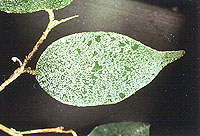
Crawler stages are susceptible to most houseplant insecticides. However, insecticides must maintain coverage throughout an entire generation of the insect (two to four months) to eliminate further infestation. Short persisting insecticides, such as pyrethrins and resmethrin, need reapplying at least once per week. Longer persisting treatments, such as bifenthrin and permethrin are effective for scale control when used at longer intervals. Soil applied systemic insecticide imidacloprid should be effective for most soft scale infestations.
Armored Scales
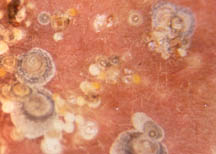
Armored scales are much less common than soft scales. Typical species are generally round, often with a distinct central spot. Many cause spotting around the feeding site. They can also cause die back when abundant. Unlike soft scales, they do not produce honeydew and, except for a very brief period after egg hatch (crawler stage), are immobile. Horticultural oils are the most effective treatment for armored scales. Systemic insecticides provide poor control and may increase populations of other pests such as spider mites if present.
Aphids
Aphids develop as pests on several types of houseplants including ornamental peppers, hibiscus, chrysanthemums, and many garden plants and herbs. Aphids also feed on plant sap and excrete large amounts of sticky honeydew. In high populations they cause wilting and distortions of new growth.
Aphids common on house plants include the green peach aphid, potato aphid, cotton/melon aphid, and chrysanthemum aphid. Populations increase rapidly as generations can be completed in two to three weeks.

Management. Since aphids are exposed on the plant, periodic washing with water and contact sprays of insecticides is effective. However, most aphids adapted to greenhouse culture, particularly the green peach aphid, are highly resistant to insecticides due to long-term exposure. Imidacloprid is particularly effective for aphids. Insecticidal soaps and pyrethroid insecticides may also be effective.
Biological controls for aphids have had modest success at best. Some aphids are best controlled by a small predator midge, Cecidomyiia aphidomyza. Mass releases of green lacewing eggs, which hatch into larvae that prey on aphids and many other insects, can also be effective.
Thrips
Thrips are extremely minute insects, usually less than 1/16 inch when full-grown. They have elongated bodies and are usually brown, although pale and dark forms can be common. Adults can fly and their very small size allows them to easily penetrate most screening.
Thrips are usually recognized by the damage they cause. Light, irregular silvery areas on the leaf surface develop around the feeding site. Tiny dark spots of excrement appear at the feeding area. This feeding may somewhat resemble spider mites, but wounds produced by thrips are larger and more silvery. Thrips infesting buds and developing flowers produce distortion and scarring of petals.
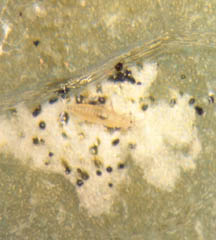
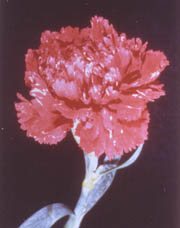
Perhaps most important is the ability of thrips to transmit certain virus diseases to plants. Tomato spotted wilt is a very serious disease, primarily affecting vegetables but also many ornamental plants. The closely related virus impatiens necrotic spot similarly has a very wide host range, particularly among ornamental plants.
Management. Many strains are resistant to insecticides and their habits make them even harder to control. Egg stages are inserted into plant parts and later immature stages (sometimes called “pupae” and “prepupae”) develop in soil where they are inaccessible to sprays.
Pyrethroid insecticides control some thrips (onion thrips) but not the most common types. Exposed stages are controlled with soaps or oils. Adults are attracted to sticky traps, particularly yellow or pale blue.
Fungus Gnats
Fungus gnats (Bradysia species) are small, dark colored flies that jump and fly across the soil surface. Adult gnats are commonly seen as they collect around windows. Fungus gnats cause little or no injury to house plants but create a serious nuisance problem. Problems are most common during winter and early spring. Since these insects develop in potting soil, virtually any houseplant can be a host for fungus gnats.
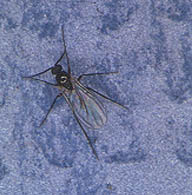
Adults live for a few days and lay eggs in soil cracks and around the base of plants. The pale colored larval (“maggot”) stage feeds on fungi and decaying organic matter. They also feed on root hairs of the plant which causes reduced plant vigor. A generation can be completed in one month.
Management. Fungus gnats are native insects and are common in lawns and garden soils. Reinfestation from these outdoor sources is very likely and difficult to completely prevent. However, fungus gnat populations can be reduced to levels that are not a serious nuisance. Since fungus gnat larvae feed primarily on decaying plant materials, changing soil moisture conditions is the most important step to take. Watering should be limited so that the soil surface can dry between waterings.
Some adults can be captured on sticky cards. However, as they are very short lived, they may have laid many eggs before being captured. Adults can also be suppressed by sprays of pyrethrins and pyrethroid insecticides. However frequent application is required to reduce adult abundance and egg laying, particularly when using insecticides of short persistence.
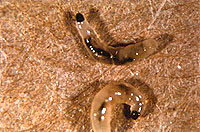
Larval control is more effective. The biological insecticide Bacillus thuringiensis var. israelensis or (H-14 strain) is highly effective as a soil drench. Some neem products are labeled for soil drench purposes and can control fungus gnat larvae. These products may be more readily acquired via mail order.
Other Flies
Sometimes other flies are associated with indoor greenhouses. Where algae develops shore flies may become established. These flies are slightly larger than fungus gnats and do not pose nuisance problems. However, adults regurgitate dark material and “fly specks” on plants. In stagnant water rich in organic matter moth flies can breed. These minute flies have a broad feathery wing that superficially resembles a small moth. Both shore flies and fungus gnats are managed by eliminating breeding sites.

Springtails
Springtails are small, gray, or cream-colored insects that feed on decaying organic matter in soil. They are most often recognized by the habit of many species to jump on the soil surface, like a small flea. They are most often observed in potted plants shortly after watering, which brings them to the surface. Springtails cause little if any damage to houseplants but can be a nuisance problem. Limiting water reduces springtail numbers.

Table 2. Summary of cultural and mechanical controls for houseplant insects and mites.
| Pest | Non-chemical Controls |
|---|---|
| Spider mites | Increase humidity around the plant; periodically hose with jet of water. |
| Greenhouse whitefly | Use sticky traps to capture the adult whiteflies; vacuum plants to capture adult stages. |
| Brown soft scale | Physically pick or rub scales to kill them; coat individual scales with alcohol. |
| Mealybug | Coat individual mealybugs with alcohol; grow plants under conditions that allow moderate growth to reduce succulence favored by many mealybugs. |
| Fungus gnats, Springtails | Avoid excessive watering; avoid use of high organic matter soils or fish emulsion fertilizers which can favor development of fungi eaten by fungus gnats. |
| Aphids | Periodically hose the plant with a vigorous jet of water. Crush individual aphids. Yellow sticky traps may capture winged adults. |
Table 3. Summary of expected performance of insecticides available for use on houseplants.
| Insecticide | Whitefly nymphs/ adults | Mealy bugs | Spider mites | Soft scale | Armored scale | Aphids | Fungus gnat (larvae/ adults) | Comments |
|---|---|---|---|---|---|---|---|---|
| Horticultural oil | Y/N | S | Y | Y | Y | S | N/N | Primarily acts by smothering; no residual effects. |
| Insecticidal soap | S/N | S | S | S* | S* | Y/S | N/N | Contact insecticide with no residual effects. |
| Pyrethrins, resmethrin, sumithrin, tetramethrin | N/S | S | S/N | S* | S* | S/N | N/Y | Short persistence (hours). |
| Permethrin, cyfluthrin | S/Y | S | N | S* | S* | S/N | N/Y | Moderately persistent (days) pyrethroids. |
| Bifenthrin | S/Y | Y | Y/S | S* | S* | S/N | N/Y | Moderate persistent pyrethroid with some activity against spider mites. |
| Neem insecticides | Y/N | N | N | N | N | S | Y/N | Acts to disrupt growth of some developing insects. |
| Neem oil | Y/N | S | S | S | S | S | N/N | Plant-derived horticultural oil. |
| Disulfoton | S/S | S | S | S | N | S | N/N | A systemic insecticide applied to soil. Highly toxic. |
| Imidacloprid | Y/C | Y | N | C | S | S | N/N | A systemic insecticide usually applied to soil; some foliar treatments are available for houseplants. |
| Bacillus thuringiensis var. israelensis (H-14) | N/N | N | N | N | N | N | Y/N | A bacterial disease of certain fly and gnat larvae. |
| Y – Yes, can provide control of the pest; S – May suppress numbers of the pest; N – Not effective for control of the pest.* Effective against the newly hatched, crawler stages of scales only. | ||||||||
Table 4: Dilution rates for small quantity sprayers.
Some pest management products sold as concentrates state use rates as a percentage dilution or dilution ratio with water. The following table is prepared to assist in computing the approximate amount to add for gallon, quart, or pint quantities of spray.
| Dilution ratio (ingredient to water) | Percent dilution | Amount to add to water (by gallon) | Amount to add to water (by quart) | Amount to add to water (by pint) |
|---|---|---|---|---|
| 1:99 | 1% | 2.5 Tbsp (-) | 2 tsp (+) | 1 tsp (+) |
| 1:49 | 2% | 5 Tbsp (-) | 4 tsp (+) | 2 tsp (+) |
| 1:32 | 3% | 8 Tbsp (+) | 2 Tbsp (+) | 1 Tbsp (+) |
| 1:24 | 4% | 10 Tbsp (-) | 2.5 Tbsp (+) | 4 tsp (+) |
| 1:19 | 5% | 13 Tbsp (+) | 3 Tbsp (-) | 5 tsp (-) |
| Tbsp = tablespoon; tsp = teaspoon. 3 teaspoons (tsp) = 1 tablespoon (Tbsp)+ Will produce a solution of a slightly higher concentration than indicated. – Will produce a solution with a slightly lower concentration than indicated. | ||||
Reference: CSU Fact Sheet 5.595