


Quick facts…
- Necrotic ring spot (NRS) is a perennial fungal disease of Kentucky bluegrass.
- NRS results in circular or doughnut-shaped patches of dead grass.
- Symptoms often develop in late July and August, with recovery in fall and spring.
- NRS can be suppressed by a combination of good turf management practices and fungicide applications.
Introduction
Necrotic ring spot (NRS) is caused by the fungal pathogen Ophiosphaerella korrae. NRS is the most destructive disease of Kentucky bluegrass in Colorado. The disease also damages red fescue and annual bluegrass. Necrotic ring spot is particularly damaging to bluegrass because it is a perennial problem where the fungus attacks and kills the grass roots and crowns. Thus, recovery from a disease outbreak is slow.
Symptoms
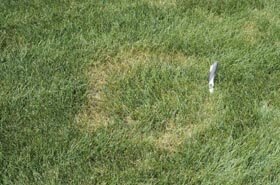
or straw colored rings or frog eyes in the lawn.
Necrotic ring spot often appears two to three years after being introduced into the lawn. Symptoms of NRS may be apparent throughout the growing season, but they commonly intensify in late July or August during periods of summer stress. Initial symptoms of new infections commonly appear in early fall or the following spring. Light green to straw-colored spots or patches several inches to several feet in diameter develop in the lawn. The patches may be localized to one part of the yard or widely scattered throughout the lawn. As the disease progresses, grass at the patch margin begins to die and becomes matted whereas the grass inside the ring remains healthy and green. This gives the patches a doughnut or frog eye pattern. Existing patches from previous years often develop a bright yellow ring, followed by plant collapse and death. Patches that develop in shady spots or areas with excessive thatch are more severely damaged and have a crater-like appearance. In successive years, rings may coalesce to create larger arcs of dead turf.
Bluegrass affected by NRS exhibits extensive root and crown discoloration and rotting. This can be observed by cutting a small sod piece from the lawn and carefully washing off soil and organic matter from roots. Darkly pigmented fungal threads are visible with a hand lens on the root surface. (This may be difficult to view since bluegrass roots have a natural tan to brown coloration).
NRS symptoms persist into early September but the turfgrass may recover during late fall and the following spring to the point where the rings are no longer visible. However, because of its perennial nature, NRS may reappear and intensify in mid-summer in successive years.
The presence of the characteristic large frogeye patches and root discoloration are usually diagnostic for NRS. [Figure 2.] However, a related disease called summer patch (caused by the fungus Magnaporthe poae) is becoming prevalent in Colorado as well. Summer patch symptoms and their time of development are somewhat similar to NRS, except that the frogeye spots associated with summer patch tend to be smaller in diameter and more numerous than those of NRS and may develop earlier in the summer. Nevertheless, the two diseases may be easily confused. Currently NRS is much more common in Colorado lawns, and summer patch should only be considered if symptoms do not quite match NRS. Confirmation of the cause of patch symptoms can be verified by a plant diagnostic laboratory.
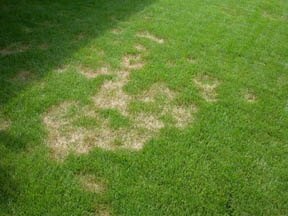
or scattered throughout the lawn.
About the Disease
Necrotic ringspot is caused by a soil-borne fungus called Ophiosphaerella korrae. The fungus survives from year to year on previously infected, dead bluegrass roots and crowns or on the surface of living roots. The fungus actively colonizes the outside of roots at soil temperatures between 65° and 80° F. These temperatures occur from mid- May through mid-September along the Front Range, but may vary somewhat on the Western Slope and at higher elevations. The fungus penetrates roots and colonizes the root cortex. This either debilitates or kills roots and leads to a decrease in water and nutrient uptake by the plant. Plants with extensively damaged root systems are more prone to injury or death, particularly during periods of high temperature or drought stress. Thus, NRS symptoms often don’t show up until July or August even though root colonization begins in May and continues throughout the summer.
Disease Management
Necrotic ring spot continues to be a very difficult disease to manage because of its perennial nature and inconsistency in control with fungicides. Nevertheless, a combination of strategies can reduce NRS severity. They include the following:
- Prepare the site before sodding or seeding. Necrotic ring spot is more severe on sites with compacted soils and poor soil drainage. It is critical to prepare the soil before lawn establishment and to make sure the site is adequately drained. On new sites, incorporating 3 to 6 cubic yards of high quality compost per 1000 square foot area as deeply as possible can mitigate sub-par site conditions.
- Resistance. Seeded lawns tend to have fewer problems from NRS than sodded lawns. Several varieties of Kentucky bluegrass including ‘Adelphi’, ‘Alpine’, ‘Apex’, ‘Award’, ‘Bristol’, ‘Classic’, ‘Eclipse’, ‘Impact’, ‘Kelly’, ‘Joy’, ‘Liberator’, ‘Midnight’, ‘Miranda’, ‘Mystic’, ‘NuBlue’, ‘Nugget’, ‘NewStar’, ‘Odyssey’, ‘P105’, ‘P104’, ‘Unique’, ‘Wabash’ and ‘Washington’ have been reported to be moderately resistant to NRS in limited field trials. Consider using these varieties when establishing a new lawn from seed or when overseeding diseased patches. Perennial ryegrass (Lolium perenne), a good textural match for Kentucky bluegrass, is immune to NRS (Worf et al. 1986).
- Do not overwater. This is perhaps the most important prevention practice for NRS. It is tempting to irrigate lawns with a history of NRS more frequently. However, this can promote new infections early in the season. Water the lawn to a depth of 6 to 8 inches as infrequently as possible, usually no more than twice a week, without creating water stress. In midsummer, infected lawns may see symptoms improve from frequent light watering because of their compromised root system, but frequent watering is not a viable long-term disease management strategy.
- Follow good management practices on established lawns. Maintain the turf at a height of 2 ½ to 3 inches. Remove no more than 1/3rd of the blade at any one mowing. Since the NRS pathogen attacks the roots and not the leaves, it is not spread by mowers. Returning clippings with a mulching mower may actually help turf recovery by recycling nitrogen during the leaf decomposition process. Core aerate established lawns at least once a year (spring or fall) to help reduce thatch buildup and improve soil drainage. Core aeration equipment may spread the NRS fungus, although this is not known to be a major means of pathogen movement.
- Avoid applying excessive amounts of nitrogen fertilizer. Applications of more than 4 lb total nitrogen per 1000 square feet per year may enhance NRS. Timing of fertilizer applications is as important as the total amount applied. Follow CSU recommendations for fertilizing Kentucky bluegrass. Apply most of the nitrogen in the fall. Spring fertilizer applications, especially fast release formulations such as urea, stimulate rapid turfgrass growth and favor NRS development. Consider the use of slow-release formulations of nitrogen if spring fertilization is necessary to maintain turfgrass color. Alternatively, apply slow release products in late fall. Late summer and fall fertilizer applications may help the grass recover from NRS more quickly. Do not apply more than 1 lb total nitrogen (fast release formulation such as urea) per 1000 sq feet at any given application date during the spring and summer. Following the late-season fertilization program helps reduce this and other lawn disease problems.
- Sulfur amendments. Sulfur amendments can reduce NRS severity. The exact mechanism by which this occurs is still unclear, although it is thought that sulfur acidifies the soil surrounding the roots and inhibits, either directly or indirectly, the NRS pathogen. Sulfur may be applied as sulfur coated urea during regular fertilization applications or as various forms of elemental sulfur. Apply the sulfur in split applications for a total rate of approximately 1 to 1.5 lbs elemental sulfur per 1000 sq feet per year. The higher rate will provide better control. Be sure to water the product into the soil to avoid leaf damage. Monitor soil pH each year and discontinue applications if the pH drops below 6.0. Ammonium sulfate, an acidifying fertilizer, may give the same control, although this product will cause foliar burning if not properly watered in after application.
- Fungicide application. Several fungicides are labeled for the control of NRS (see Table 1) but their effectiveness has been inconsistent. While these products are not restricted use they, for the most part, are not are not packaged for sale at retail outlets. Therefore, these fungicides are usually applied by professional lawn care operators.
- Fungicide timing. Fungicide timing is critical for disease control. Products must be applied preventatively, i.e. in spring before root colonization by the fungus occurs. This usually occurs in mid-May on the Front Range. Apply when soil temperatures reach 65° F at a depth of 2 inches. Do not make the first application too early in the spring because fungicide activity may be lost before the fungus starts colonizing roots. Preventative fungicides may need to be reapplied during the growing season at regular intervals, read and follow instructions on the product label.
Table 1. Fungicide products and effectiveness.
| Fungicide (Active Ingredient) | Efficacy |
|---|---|
| azoxystrobin | Limited efficacy |
| azoxystrobin +propiconazole | Fair to good |
| iprodione | Fair to good |
| fenarimol | Good to excellent |
| myclobutanil | Fair to good |
| propiconazole | Fair to good |
| Thiophanate methyl | Fair to good |
| tebuconazole | Fall applications good |
References
Worf GL, Stewart JS, and Avenius RC 1986. Necrotic Ring Spot Disease of Turfgrass in Wisconsin. Plant Disease 70(5) pp 453-458.
Reference: CSU Fact Sheet 2.900