


Quick facts…
- Select plants with uniformly green foliage and no lower leaves missing.
- Poinsettias need moderately moist soil; water thoroughly whenever the soil feels dry to the touch.
- Ideal temperatures are 60F to 70F.
- Poinsettia plant parts are not edible, but they are not poisonous when eaten.
- Those sensitive to latex may develop a rash when handling poinsettias.
History and Description
The poinsettia (Euphorbia pulcherrima) has been cultivated for centuries, beginning with indigenous peoples in its native Central America. Wild poinsettias are shrubs that grow in scrublands in Mexico.
Active breeding of the poinsettia began in the 1950s in an effort to develop varieties that would retain their leaves and colorful bracts for a longer period. Early breeding efforts included those of Mikkelsen of Ohio (Mikkelsen series), the Heggs of Norway (Hegg series), as well as those of the Ecke family of California (Eckespoint series). The Fischer family, a German breeder, has also contributed many cultivars to the poinsettia tradition. These breeding programs focused on stronger stems, leaf and bract retention, multiple branching, earlier blooming, and color variation.
Modern cultivars are bred to last longer in the home, bloom earlier, and require fewer resources for production than older varieties. This translates into more color selections and better-quality plants for consumers. Poinsettias are available in a vast array of colors from red to white, pink to burgundy, and even orange.
Selection
Poinsettias thrive on indirect, natural daylight — at least six hours a day. Avoid direct sunlight, as this may fade the bract color. If direct sun cannot be avoided, diffuse the light with a shade or sheer curtain. To prolong color, protect plants from cold drafts and excessive heat. Ideal temperatures are 67F to 70F during the day and 60F to 62F at night. Remove damaged or diseased leaves.
Poinsettias require moderately moist soil but are susceptible to root rots in overly wet soil. Check plants daily and water thoroughly whenever the soil feels dry to the touch. Plants in clay pots require more water, while those in plastic pots are easily overwatered. Do not allow poinsettias to sit in standing water. If the container is wrapped with foil, remove it when watering or make a hole in it for drainage. Discard any collected water in the drainage receptacle.
A poinsettia does not require fertilization while it is in bloom. However, to maintain green foliage and promote new growth indoors after the holidays, apply a balanced all-purpose house plant fertilizer once per month. Always follow the directions on the fertilizer label.
Cultural Requirements
Poinsettias do well in the home and can keep their color until mid-March. The showy red, pink, white, yellow, bicolored, or speckled modified leaves are called bracts. With proper light and temperature, they accumulate the anthocyanin pigments that give them their color. The minute true flowers (cyathia) of the poinsettia are held on the stem above the bracts. Most noticeable is a yellow-edged nectary with sweet, fragrant nectar.
When purchasing poinsettias, choose a plant with uniformly dark green foliage. Note that some cultivars with lighter colored or mottled bracts can have lighter green foliage than red forms—focus on uniform color both in individual leaves and across the whole plant.
Pale green, yellow, or shriveled, fallen leaves may indicate plants with a root disease problem, that have been overwatered, had an excessive dry period, or received limited fertilization. Bracts should be well developed with little pollen showing on the flowers.
When outside temperatures are below 35F, be sure the plant is well wrapped or sleeved before transporting. Low temperatures, even for short periods, can damage leaves and bracts. Remove sleeves promptly to prevent epinasty, a downward bending of the petioles, which are the slender stalks that attach the bracts to the stem.
Reflowering
To “reflower” poinsettias for the next year, strictly follow these simple steps. After a plant has passed its stage of usefulness, usually by late March or early April, remove the bracts and upper portions of the stems. This cutting back can be done any time through mid-July, depending on the desired final size and shape of the plant. Leave three or four leaves on each remaining stem.
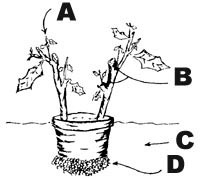
after danger of spring frosts. A: New shoots pinched in late August.
B: Early summer pruning. C: Garden soil. D: Gravel.
During late spring and early summer, move the plant to the next larger size pot. Use a well-drained potting medium, preferably heat-pasteurized. Use any well drained soil, such as a blend of equal parts sphagnum peat moss, vermiculite, and/or perlite. Thoroughly mix 1 tablespoon of triple superphosphate fertilizer (0-46-0) in each gallon of soil mix. Apply a slow-release fertilizer to the soil surface.
Prune tall growth at approximately six-week intervals to keep the plant well formed. The last pruning or pinch before flowering should occur in late August. The poinsettia is a naturally woody plant that can easily be trained into many shapes during summer pruning. Consider a poinsettia tree, hanging basket or other artistic creations. Just remember to heed the last pinching date and the darkness requirement to achieve your masterpiece by the holidays.
Indoors, place the poinsettia in a bright area where the temperature will remain constant. Water as needed and fertilize with a complete fertilizer every two to three weeks. During the summer, the plant may go outdoors in a partly shaded area. After the danger of frost is past in the spring, and minimum temperatures reach 55F, place the plant on the patio or sink it into the ground. Slightly shaded locations are ideal (see Figure 1). If the pot is in the ground, turn it weekly to prevent roots from growing through the drainage hole. Bring plants into the house when night temperatures are colder than 55F (approximately September 1 at lower elevations in Colorado). Continue fertilizing and watering to encourage good growth.
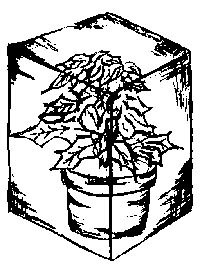
plant in darkness for 14 hours a day. Start October 1 and
continue until color shows in top bracts.
Poinsettias are short-day photoperiodic plants. This means they set buds and produce flowers as the autumn nights lengthen, blooming naturally during November or December. To flower and develop colored bracts, a poinsettia must receive ample light during the day. Starting around October 1, it also needs at least 14 hours of uninterrupted darkness each night at temperatures between 60 and 70F in order to flower. Bright stray light of any kind (nearby streetlights, pool lights, or indoor lamps) could delay or entirely halt the reflowering process. The dark treatment should last until color just shows in the bracts (usually around Thanksgiving). Some modern cultivars may show color as much as two weeks before Thanksgiving.
Disease and Pest Control
Many pests can infest poinsettias. Wash off insects with mild soap and water, using a sponge or gentle spray. Mealybugs and whiteflies may require pesticide application or removal of infested plant parts. To remove mealybugs, apply ordinary rubbing alcohol with a cotton swab.
Cold, moist soil temperatures encourage root diseases. If lower leaves start turning yellow and fall off, a root rot condition may exist. Adjust your watering practices to keep the plants drier. If desired, apply an all-purpose fungicide (usually available at garden centers) as a soil drench according to label instructions.
The milky sap that exudes from a poinsettia when damaged is a natural defensive compound called latex and is not the result of any insect or disease infestation.
Poinsettia Not Poisonous
Like other non-food items, poinsettia plants are not edible and are not intended to be eaten. Poinsettias are a member of the Euphorbiaceae family of plants. Other economically important species in this family include: The cultivated rubber tree Hevea brasiliensis, Manioc or cassava (Manihot esculenta), and Castor bean (Ricinus communis). With its close genetic ties to the rubber tree, which is where natural latex is derived, those who are sensitive may also be sensitive to the latex from poinsettias. Keep plants out of reach of small children.
Although commonly assumed to be poisonous, Poinsettia plants are not harmful to humans or household pets unless the leaves and bracts are eaten in very large quantities. The POISINDEX® Information Service, the primary resource used by most poison control centers, states that a 50-pound child would have to eat more than 500 poinsettia bracts to experience symptoms. Some cats that chew on the leaves may salivate and can vomit if the leaves are swallowed. Since cats and puppies frequently chew on new plants introduced to the home, it is prudent to place the plants out of reach!
References
Ball Red Book, 15th edition. 1991. Vic Ball, editor. Reston Publishing Co., Reston, Virginia.
Ecke, P., Jr., O.A. Matkin, and D.E. Hartley. 1990. The Poinsettia Manual, 3rd edition. Paul Ecke Poinsettia Ranch, Encinitas, California.
Lieberth, J.A., 1987. “New Horizons for Poinsettias.” Greenhouse Grower, (Feb.), pp. 10-13.
Reference: CSU Fact Sheet 7.412