

Growing the Spark
4-H Youth Development
When you join 4-H in the Southeast Area, you are part of the broader Colorado 4-H youth development community, which includes 10,000+ volunteers and more than 1000,000 youth. This gives you opportunities to participate in clubs and other local programs, as well as opportunities at the state and national level.
How to get started:
- Review the FAQ section to learn more about the 4-H program.
- Find your county to explore local clubs and resources.
- Contact your local Extension office to complete the enrollment process and pay fees.
FAQs
4-H is America’s largest youth development organization—empowering millions of young people across the U.S. with new skills and learning experiences. 4‑H serves youth through a network of caring adult volunteers, hands-on projects and programs, and meaningful leadership opportunities. Young people experience 4‑H through 4-H clubs, in-school and after-school 4-H programs, 4‑H camps, and more.
Youth who are 8-18 years old are welcome to join 4-H. A youth’s “4-H age” is determined by how old they are on December 31 of the current school year.
Youth who are 5-7 years old are eligible for the 4-H Cloverbuds program.
The Southeast Area includes Baca, Bent, Cheyenne, Crowley, Kiowa, Otero, and Prowers counties. If you live in one of these counties, we can help you join 4-H. Follow these steps to get started:
- Find your county to explore local clubs in your area.
- Explore projects and find what sparks your interest.
- Create an online 4-H profile. Once registered, your new 4-H club will provide additional information about project materials, meetings, events, and other opportunities.
- Pay annual 4-H enrollment fee. Fees are paid at your county Extension Office.
A 4‑H project is a structured, hands-on learning experience that a 4‑H member chooses to work on, in depth, over time, guided by caring adults and built around real‑world skills. In addition to the project itself, youth share what they’ve learned through demonstrations, exhibits, presentations, or community service. 4-H projects help young people gain knowledge, skills, and confidence by actively exploring a topic they care about. Key features of a 4‑H project include:
- Youth‑chosen: Members select topics that match their interests.
- Experiential: Youth learn through doing, practicing, and reflecting—not just listening.
- Goal‑oriented: Projects involve setting goals, keeping records, and working toward improvement.
- Skill‑building: Projects develop technical skills as well as life skills like responsibility, problem‑solving, leadership, and communication.
- Ongoing: Projects are typically worked on over several months or a year, with increasing levels of challenge.
For information on types of projects, see 4-H Projects and Programs.
A 4-H club is one of several 4-H positive youth development programs. Clubs help youth complete their 4-H project requirements and participate in other learning opportunities. Organized 4-H clubs include community clubs, in-school clubs, after-school clubs, and military clubs. Other 4-H programs include school enrichment programs, after-school programs, special interest/short-term programs, and camping programs. Enrollment, registration, and participation requirements vary by program. 4-H clubs and groups are required to charter each 4-H year, which begins on October 1 and runs through September 30 of the following year. A 4-H community club member must:
- Be of the appropriate 4-H age (8-18 as of December 31 of the current 4-H year)
- Note: Cloverbuds are 5-7 years old as of 12/31 of the current 4-H year.
- Enroll in 4-H via 4-H Online.
- Enroll in at least one 4-H project per year.
- Sign a 4-H member Code of Conduct.
- Pay state and local 4-H fees.
- Complete any additional county level requirements.
Membership costs vary slightly from county to county. Additional fees may apply for some projects. Please contact your county 4-H representative for more information.
Find your county




Youth leadership
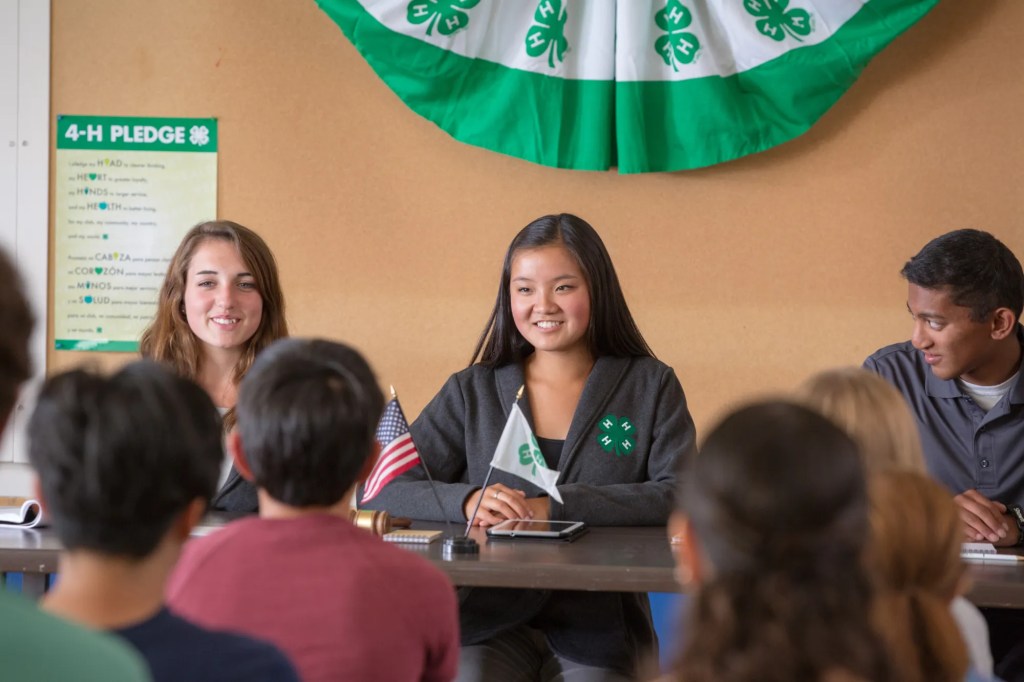
Building leadership skills is a core component of the 4‑H experience. Members have multiple opportunities to grow as leaders, including:
- 4-H Club Officers – Each club elects officers who help run meetings and guide club activities. Common officer roles include President, Vice President, Secretary, Treasurer, Historian, and Council Representatives.
- 4-H Council Officers – These youth leaders represent area 4‑H clubs as part of a unified council. They make decisions that shape the local 4‑H program and help plan events throughout the year.
- 4-H Committee Members – Youth representatives serve on a variety of committees to provide their perspective and help organize events such as clinics, shows, and more.
- 4-H State Officer – Senior 4‑H members interested in travel, teamwork, and advanced leadership development can run for District or State officer positions. This role offers a unique opportunity to collaborate with peers statewide and strengthen leadership skills.
4-H volunteers
Volunteers help make up the core of 4-H and are critical to the success of youth members. In Colorado, there are more than 8,000 volunteers who give their time, skills, and talents to help youth.
These volunteers serve in a number of capacities. Some choose to help at summer camps, teach a workshop, or lead a club. Others chaperone events, lend their professional skills, develop lessons, or help at the county fair.
As they provide guidance, experience, and mentorship, 4-H adult volunteers also offer young people another critical component: a healthy adult role model who helps them grow their confidence and explore their dreams for the future.

Cottage Food Online Safety Training
Online
Online

Outdoor Recreation Knowledge Exchange Webinar Series
Online
Zoom Webinar
Cottage Food Online Safety Training
Online
Online
Outdoor Recreation Knowledge Exchange Webinar Series
Online
Zoom Webinar