


Quick facts…
- Greenhouse whitefly is a major pest of ornamentals and vegetable crops, particularly in greenhouses and indoor plants.
- In summer, they can quickly become established in the garden and impact a wide variety of crops including tomato, cucumber lettuce, beans, begonias, hibiscus and more.
- It does not survive outdoors in areas of freezing winters, such as Colorado. Winter infestations may persist only indoors.
- Prevention and early detection are the most effective management techniques for whitefly monitoring and control.
- Yellow sticky traps and biological controls are effective tactics in whitefly prevention and management
Introduction
The greenhouse whitefly, Trialeurodes vaporariorum, is a species of whitefly that was established in Colorado. Despite their name, the greenhouse whitefly is not a true fly but are “true bugs” (Hemiptera) along with aphids, mealybugs, and scale. Like all true bugs, whiteflies are characterized by their piercing-sucking mouth parts and cause damage by sucking sap from the plant, primarily from the phloem. Heavy infestations cause a decline in plant vigor. Stunting, yellowing of foliage and premature leaf drop are among the symptoms of injury. Whiteflies also excrete sticky honeydew during feeding. This sticky honeydew detracts from plant appearance, reduces market value, and encourages gray sooty mold fungi to grow on the fruit and foliage.
The greenhouse whitefly has a host range of more than 250 ornamental and vegetable plants. Poinsettia, begonia, nicotiana, aster, calendula, cucumber, lantana, tomato, grape, ageratum, bean, and hibiscus are commonly infested.
Recently, the silverleaf whitefly, (Bemisia tabaci strain B) has become established in some Colorado greenhouses. Also known as the sweetpotato or poinsettia whitefly, this whitefly has become endemic in the southwestern United States and in Florida. It causes serious damage to vegetable crops and ornamental plants and is a vector of plant viruses, including squash vein virus, tomato yellow leaf curl virus and Cucurbit leaf crumple virus. Fortunately, in Colorado, it is far less common.
Life History and Habits
The greenhouse whitefly is a tropical/subtropical species that cannot overwinter outdoors in Colorado. Freezing temperatures kill it and the lack of host plants prevents its survival, except under highly protected conditions. Although whiteflies produce several generations of outdoor plants during the summer (notably tomato, pepper, and cucumber), year-round infestations are only possible indoors.
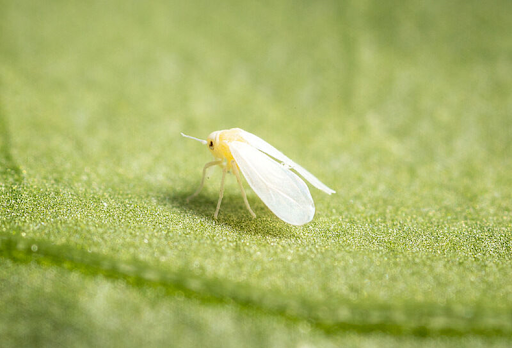
Adult greenhouse whiteflies are about 1/16” long, with four white, membranous wings held parallel to the top of the body (fig. 1). Because of the insect’s mobility, most infestations come from adult females moving to new plants. When a host plant is found, females insert their mouthparts into the phloem and lay a series of eggs in a semicircular pattern on the underside of the newest leaves. The small, oval creamy yellow eggs darken after 24 hours and nymphs emerge within five to seven days. Nymphs move a short distance before flattening themselves against the leaf to feed. All remaining immature stages of the greenhouse whitefly are immobile.
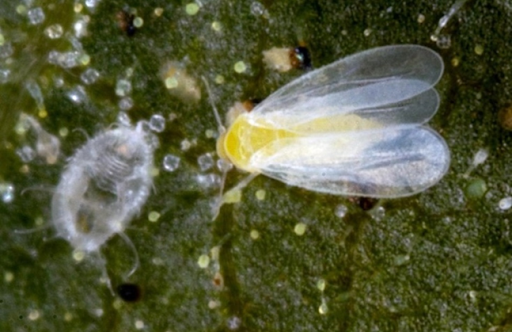
There are three nymphal stages that feed on the plant, spaced at two-to four-day intervals, followed by a nonfeeding “pupal” stage that lasts almost a week. All the immature stages are inconspicuous, easily overlooked and best identified with a hand lens. Nymphs are translucent to pale yellow and are superficially similar to certain scale insects. Late-stage nymphs and pupae may also have thin
waxy threads that can resemble those produced by mealybugs (fig. 2).
Adult whiteflies emerge from a slit that develops along the back of the pupal skin. Ratios of male to female whiteflies vary, with more females occur in late spring than in winter. Each female can lay 400 eggs over a period of up to two months. Under favorable conditions, a generation of the greenhouse whitefly takes three to four weeks to complete.
Control of Whiteflies
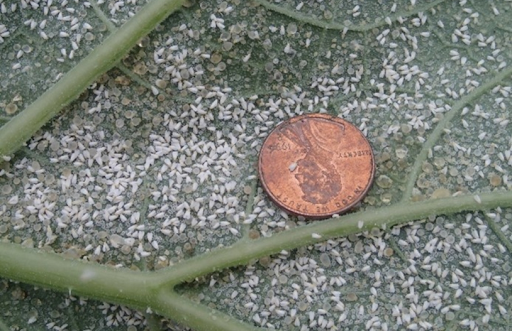
Prevention and early detection are the best control for whiteflies. Since infestations originate only from infested plant materials, inspection and quarantine of new plants is recommended. Eggs and nymphs can be identified by inspecting the underside of leaves with a hand lens. And since adults occur in dense colonies, gently brushing plants will quickly identify any adults (fig. 3). After inspection, plants should be isolated in a separate area or bench for 1-2 weeks and monitored regularly.
Sanitation is also a preventative measure. Whitefly nymphs can continue to mature on dead/dying plants and produce more adults. Remove plant residue within and around host plants and discard dead plants immediately. Whiteflies also feed on many weed species, so it’s important to remove weeds from greenhouse, outdoor gardens, and all perimeters.
Once the insects are established in a greenhouse, a host-free period can starve them. This might mean removing all host plants for 2-3 weeks. If removing host plants is not possible, a comprehensive management plan is required.
Monitoring and Trapping
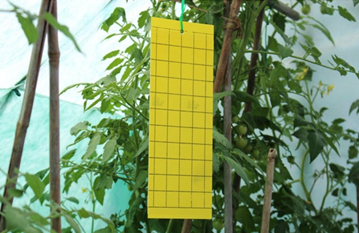
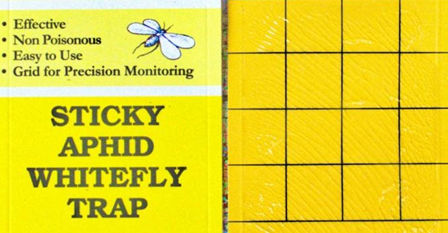
Adult whiteflies are highly attracted to yellow and white and are often found on lighter colored foliage. Yellow sticky traps can be used both to monitor adult whitefly populations and to help suppress populations (fig. 4). These yellow sticky cards, found in any garden center, garden catalog or on-line retailer, are hung just above the crop canopy to detect, monitor and trap adult whiteflies. Yellow sticky cards should be placed 1 per 1000ft2 and replaced weekly. Detecting nymphs is done by monitoring the underside of leaves with a hand lens.
Biological Controls
Biological controls are highly effective when applied as a preventative or at low populations of whitefly. There are two commercially parasitic wasps available in the United States: Encarsia formosa and Eretmocerus eremicus (formerly californicus). E. formosa females lays her eggs inside the immature whitefly nymphs. Young whiteflies turn black and die in several days (fig. 5). E. formosa is native to temperate and subtropical regions, therefore is most effective at temperatures between 68°-77°F.

Eretmocerus eremicus also parasitizes immature whitefly nymphs, but effective on both the greenhouse whitefly (Trialeurodes vaporariorum) and the sweet potato whitefly (Bemisia tabici strain B). Additionally, E. eremicus prefers warmer temperatures and is ideal for warmer summer months. Two other beneficial insects that feed on eggs and whitefly nymphs include the ladybird beetle (Delphastus pusillus) and the predatory mite Amblyseius swirskii.
In addition to beneficial insects, Beauveria bassiana (trade name Botaniguard) is a fungal pathogen that is effective at control. B. bassiana is a live fugus that grows and feeds on the insects and then kills them.
It is important to note that biological controls do not provide rapid suppression of large populations. They are best applied preventatively, so they stay ahead of the pests. If you have a susceptible crop, such as tomatoes or poinsettias, release beneficials early.
Chemical control
Chemical/insecticidal control can be difficult because whiteflies can quickly build up resistance to them, and many are not compatible with beneficial or pollinator insects. Furthermore, egg and the nonfeeding pupal stages are generally not susceptible to insecticides that can kill adults and nymphs. Thus, repeated applications are usually required.
The most effective insecticide for whitefly nymphs is imidacloprid (Marathon). This has systemic properties and is usually used as a soil application, taken into the plant via the roots. It is not registered for most homegrown vegetables but can be used in flower beds and houseplants. Note that imidacloprid, when used as a spray, can have negative impacts on natural enemies, honey bees, pollinators and can cause spider mite outbreaks.
Horticultural oils (SunSpray), insecticidal soaps (M-pede), and Neem oils are less toxic to beneficial insects and effective at reducing whitefly populations. Oils and soaps work by suffocating the immature nymphs and eggs, therefore must come in direct contact with insects to kill them. Thorough coverage, including the underside of leaves, is required to suppress population. Applications should be repeated every 7-10 days until eggs/nymphs are no longer present. Application of oils and soaps should be done early in the day or late in the evening to avoid leaf scorching or phytotoxicity.
References
Frank, S. 2017. Whitefly Control with biocontrol. Greenhouse Management. Available: https://www.greenhousemag.com/article/whitefly-control-with-biocontrols/
Koppert. 2025. Biological Controls. Available: https://www.koppertus.com/crop-protection/biological-pest-control/parasitic-wasps/eretmocerus-eremicus
UC IPM. 2015. Whiteflies. University of California-Agriculture and Natural Resources. Available: https://ipm.ucanr.edu/PMG/PESTNOTES/pn7401.html
Wollaeger, H and Smitley, D. 2016. Controlling whitefly in the greenhouse. Michigan State University Extension. Available: https://www.canr.msu.edu/news/controlling_whitefly_in_the_greenhouse#
Reference: CSU Fact Sheet 5.587